- Published on
Using Zombie Objects to Aid Debugging
Introduction
I'd heard of zombie objects before, but only had a vague understanding — something like memory that hasn't been referenced but also hasn't been overwritten.
NSZombie Object
Cocoa provides a "Zombie Objects (NSZombie Object)" feature. When enabled, the runtime converts all deallocated instances into special "zombie objects" rather than truly reclaiming them (a vivid metaphor — undead, not yet buried). The underlying memory of these objects cannot be reused and therefore cannot be overwritten. When a zombie object receives a message, it throws an exception that precisely identifies the message sent and describes the object as it was before deallocation.
When you send a message to a deallocated object, a crash doesn't always occur: whether it crashes depends on whether the object's memory has been overwritten by something else.
How to Enable
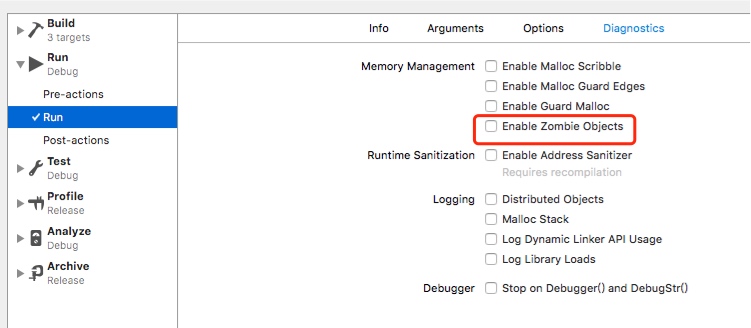
In Xcode, set NSZombieEnabled to YES to enable this feature. Specifically: open Edit Scheme, select Run, switch to the Diagnostics tab, and check Enable Zombie Objects.
How It Works
The NSZombie Object implementation lives in the OC runtime library, the Foundation framework, and the CoreFoundation framework (I haven't been brave enough to dig into those yet). When the system is about to deallocate an object and finds that zombie objects are enabled, it converts the object to a zombie instead of fully reclaiming it.
Since reproducing zombie objects under ARC requires more complex setup, here's a simple MRC example:
void PrintClassInfo(od obj) {
    Class cls = object_getClass(obj);
    Class superCls = class_getSuperclass(cls);
    NSLog(@"---%s : %s---", class_getName(cls), class_getName(superCls));
}

int main(int argc, char *argv[]) {
    Person *p = [[Person alloc] init];
    NSLog(@"Before release:");
    PrintClassInfo(p);
    [p release];
    NSLog(@"After release:");
    PrintClassInfo(p);
}
PrintClassInfo prints the class and superclass of an object. The output is:
Before release:
---Person : NSObject ---
After release:
---_NSZombie_Person : nil ---
The object's class has changed from Person to _NSZombie_Person. _NSZombie_Person is generated at runtime: the first time a Person object needs to become a zombie, this class is created using the runtime and registered in the class list.
A zombie class is copied from a template class named _NSZombie_. These zombie classes don't do much — they serve mainly as markers. The pseudocode below shows how the system creates a zombie class on demand, and how that class transforms the object being deallocated into a zombie:
//Get the class of the object being deallocated
Class cls = object_getClass(self);

//Get the class name
const char *clsName = class_getName(cls);

//Build the zombie class name
const char *zombieClsName = "_NSZombie_" + clsName;

//Check if the zombie class already exists
Class zombieCls = objc_lookUpClass(zombieClsName);

//If not, create it
if(!zombieCls){
    //Get the _NSZombie_ template class
    Class baseZombieCls = objc_lookUpClass("_NSZombie_");

    //Duplicate _NSZombie_ with the new class name
    zombieCls = objc_duplecateClass(baseZombieCls, zombieClsName, 0);
}

//Manually clean up the object's resources
objc_destructInstance(self);

//Set the deallocated object's class to the zombie class — the object is now a zombie
objc_setClass(self, zombieCls);
This is essentially what NSObject's dealloc method does when NSZombieEnabled = YES — the runtime swaps out dealloc for the code above. By the end, the object's class has become _NSZombie_Person.
The key point: the object's memory is not freed (via free()), so it cannot be reused. Of course, this is only a debugging aid — production code should never do this.
The reason a new class is created for each zombie is so the system can identify the original class when a message is sent to the zombie. Otherwise all zombies would belong to _NSZombie_ and debugging would be impossible. The new class is created by the runtime function objc_destructInstance(), which copies the entire _NSZombie_ class structure and assigns it a new name. The copy inherits the same superclass, instance variables, and methods. An alternative would be to subclass _NSZombie_, but copying is more efficient.
The zombie class's role becomes apparent during message forwarding. The _NSZombie_ class implements no methods and has no superclass — only an isa instance variable (required by all OC root classes such as NSObject). Because it implements no methods, all messages sent to it go through the full forwarding mechanism.
In the full message forwarding mechanism, ___forwarding___ is the core function — you'll see it in the call stack during debugging. The first thing it does is check the class name of the message recipient. If the name has the prefix _NSZombie_, it means the recipient is a zombie object and needs special handling. At that point, a message like this is printed:
*** -[receiver messageSelector:]: sent to deallocated instance 0x7ff9e9c080e0
This identifies the message sent to the zombie and the class it belonged to, then the application terminates. The original class name can be extracted from the zombie class name.
//Get the object's class
Class cls = object_getClass(self);

//Get the class name
const char *clsName = class_getName(cls);

//Check whether the class name starts with _NSZombie_
if (string_has_prefix(clsName, "_NSZombie_")) {
    //This is a zombie object
    //Get the original class name
    const char *originalClsName = substring_from(clsName, 10);

    //Get the selector name
    const char *selectorName = sel_getName(_cmd);

    //Print the information
    Log("*** -[%s %s]: message sent to deallocated instance %p", originalClsName, selectorName,self);

    //Terminate the app
    about();
}
If zombie objects are enabled in the example at the beginning of this post, and you send the description message to the released Person instance, the output will be:
*** -[Person description]: message sent to deallocated instance 0x7f8123c1ac200
Summary
-
During debugging, you can enable the zombie objects feature to convert objects that would normally be deallocated into zombie objects instead.
-
The system modifies the object's
isapointer to point to a zombie class. The zombie class responds to all messages by printing a message containing the selector name and the receiver, then terminating the application.