- Published on
Design Patterns in iOS — Builder
Builder Pattern
Builder Pattern: Separates the construction of a complex object from its representation, so that the same construction process can create different representations.
Sometimes there are multiple ways to build an object. If this logic is crammed into a single method of the class responsible for building the object, the code will be riddled with conditional branches. Breaking the construction process into a client-director-builder relationship makes it far easier to manage and reuse. The design pattern that models this relationship is called the Builder.
Class Diagram
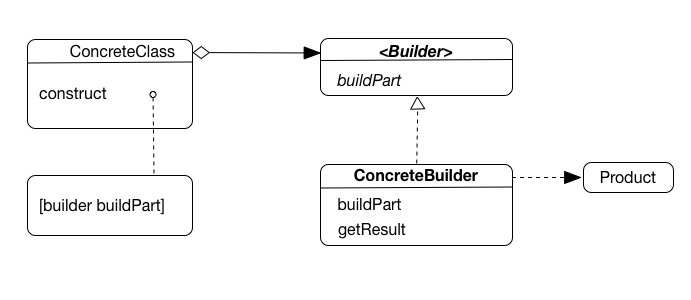
Builder is an abstract interface that declares a buildPart method. This method is implemented by ConcreteBuilder to construct the actual product (Product). ConcreteBuilder has a getResult method that returns the finished Product to the client. Director defines a construct method that tells the Builder instance to buildPart. Director and Builder form an aggregation relationship, meaning Builder is a component that works together with Director to make the whole pattern function, yet Director is not responsible for the lifecycle of Builder. This "whole-part" relationship is illustrated by the following sequence diagram:
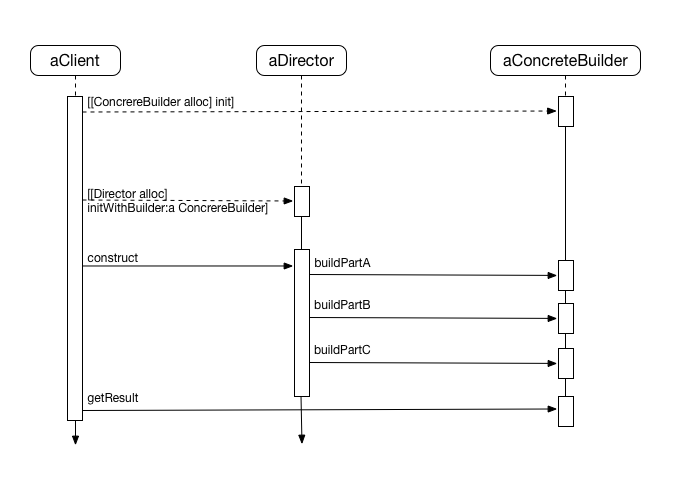
aClient creates an instance of ConcreteBuilder (aConcreteBuilder) and an instance of Director (aDirector) initialized with aConcreteBuilder, so they can collaborate going forward. When aClient sends the construct message to aDirector, that method sends build-what messages (such as builderPartA, builderPartB, and builderPartC) to aConcreteBuilder. After aDirector's construct method returns, aClient sends getResult directly to aConcreteBuilder to retrieve the finished product. In other words, what aDirector "knows" is simply what parts each Builder is capable of building.
When to Use
-
When you need to create complex objects that involve various components. The algorithm for creating the object should be independent of how the parts are assembled. A common example is constructing composite objects.
-
When the construction process needs to produce objects in different ways (e.g., different combinations of components or representations).
Builder vs. Abstract Factory
The two patterns share some similarities. However, Builder focuses on constructing a complex object step by step — often the same type of object can be built in different ways. Abstract Factory, on the other hand, emphasizes creating families of simple or complex products. Builder returns the product at the last step of a multi-step process, whereas Abstract Factory returns the product immediately.
| Builder | Abstract Factory |
|---|---|
| Constructs complex objects | Constructs simple or complex objects |
| Builds the object in multiple steps | Builds the object in a single step |
| Builds the object in multiple ways | Builds the object in a single way |
| Returns the product at the final step | Returns the product immediately |
| Focused on one specific product | Emphasizes a family of products |
Usage Example
We define a class called ChasingGame with two methods for creating two types of characters — a player and an enemy. CharacterBuilder is used to build characters; each attribute influences the traits of the character being built. The class diagram showing these static relationships looks like this:
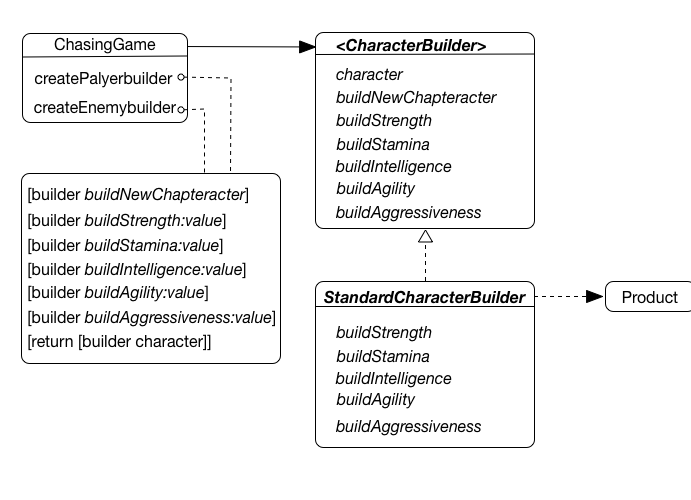
CharacterBuilder is the abstract builder, StandardCharacterBuilder is the concrete builder, and ChasingGame is the director.
ChasingGame defines createPlayer:builder and createEnemy:builder, creating player and enemy characters via an instance of CharacterBuilder. Each method uses a different set of characteristic factors to define the character's traits. StandardCharacterBuilder is the concrete CharacterBuilder that actually builds the character based on these factors. Once construction is complete, StandardCharacterBuilder returns an instance of Character.
//Character.h
@interface Character : NSObject
@property (nonatomic, assign) float protection;//defense
@property (nonatomic, assign) float power;//attack
@property (nonatomic, assign) float strength;//strength
@property (nonatomic, assign) float stamina;//stamina
@property (nonatomic, assign) float intelligence;//intelligence
@property (nonatomic, assign) float agility;//agility
@property (nonatomic, assign) float aggressiveness;//aggressiveness
@end

//Character.m
@implementation Character
- (instancetype)init {
    self = [super init];
    if (self) {
        self.protection = 1.f;
        self.power = 1.f;
        self.strength = 1.f;
        self.stamina = 1.f;
        self.intelligence = 1.f;
        self.agility = 1.f;
        self.aggressiveness = 1.f;
    }
    return self;
}
@end
A Character instance has no idea how to build itself into a meaningful character, which is why CharacterBuilder is needed — it constructs a meaningful character based on the characteristic relationships defined earlier.
//CharacterBuilder.h
@interface CharacterBuilder : NSObject
@property (nonatomic, strong) Character *character;
- (CharacterBuilder *)buildNewChapteracter;
- (CharacterBuilder *)buildStrength:(float)value;
- (CharacterBuilder *)buildStamina:(float)value;
- (CharacterBuilder *)buildIntelligence:(float)value;
- (CharacterBuilder *)buildAgility:(float)value;
- (CharacterBuilder *)buildAggressiveness:(float)value;
@end
The CharacterBuilder instance holds a reference to the target Character being built, which will be returned to the client once construction is complete. There are several methods for building a character with specific strength, stamina, intelligence, agility, and aggressiveness values. These values affect the defense and attack factors. The abstract CharacterBuilder defines the default behavior by assigning these values to the target Character.
//CharacterBuilder.m
@implementation CharacterBuilder
- (CharacterBuilder *)buildNewChapteracter {
    self.character = [[Character alloc] init];
    return self;
}
- (CharacterBuilder *)buildStrength:(float)value {
    self.character.strength = value;
    return self;
}
- (CharacterBuilder *)buildStamina:(float)value {
    self.character.stamina = value;
    return self;
}
- (CharacterBuilder *)buildIntelligence:(float)value {
    self.character.intelligence = value;
    return self;
}
- (CharacterBuilder *)buildAgility:(float)value {
    self.character.agility = value;
    return self;
}
- (CharacterBuilder *)buildAggressiveness:(float)value {
    self.character.aggressiveness = value;
    return self;
}
@end
The buildNewChapteracter method of CharacterBuilder creates a new Character instance to be built. StandardCharacterBuilder is a subclass of CharacterBuilder that defines the logic for building genuine characters with various related traits.
//StandardCharacterBuilder.h
@interface StandardCharacterBuilder : CharacterBuilder
- (CharacterBuilder *)buildStrength:(float)value;
- (CharacterBuilder *)buildStamina:(float)value;
- (CharacterBuilder *)buildIntelligence:(float)value;
- (CharacterBuilder *)buildAgility:(float)value;
- (CharacterBuilder *)buildAggressiveness:(float)value;
@end

//StandardCharacterBuilder.m
@implementation StandardCharacterBuilder
- (CharacterBuilder *)buildStrength:(float)value {
    self.character.protection *= value;//update character's defense value
    self.character.power *= value;//update character's attack value
    return [super buildStrength:value];//set strength and return this builder
}
- (CharacterBuilder *)buildStamina:(float)value {
    self.character.protection *= value;//update character's defense value
    self.character.power *= value;//update character's attack value
    return [super buildStamina:value];//set stamina and return this builder
}
- (CharacterBuilder *)buildIntelligence:(float)value {
    self.character.protection *= value;//update character's defense value
    self.character.power /= value;//update character's attack value
    return [super buildIntelligence:value];//set intelligence and return this builder
}
- (CharacterBuilder *)buildAgility:(float)value {
    self.character.protection *= value;//update character's defense value
    self.character.power /= value;//update character's attack value
    return [super buildAgility:value];//set agility and return this builder
}
- (CharacterBuilder *)buildAggressiveness:(float)value {
    self.character.protection /= value;//update character's defense value
    self.character.power *= value;//update character's attack value
    return [super buildAgility:value];//set aggressiveness and return this builder
}
@end
//ChasingGame.h
@interface ChasingGame : NSObject
- (Character *)createPlayer:(CharacterBuilder *)builder;
- (Character *)createEnemy:(CharacterBuilder *)builder;
@end

//ChasingGame.m
@implementation ChasingGameß
- (Character *)createPlayer:(CharacterBuilder *)builder {
    [builder buildNewChapteracter];
    [builder buildStrength:50.0];
    [builder buildStamina:25.0];
    [builder buildIntelligence:75.0];
    [builder buildAgility:65.0];
    [builder buildAggressiveness:35.0];

    return [builder character];
}
- (Character *)createEnemy:(CharacterBuilder *)builder {
    [builder buildNewChapteracter];
    [builder buildStrength:80.0];
    [builder buildStamina:65.0];
    [builder buildIntelligence:35.0];
    [builder buildAgility:25.0];
    [builder buildAggressiveness:95.0];

    return [builder character];
}
@end
The client creates a StandardCharacterBuilder and a ChasingGame instance, then sends the createPlayer: and createEnemy: messages to ChasingGame.
ChasingGame *game = [[ChasingGame alloc] init];
CharacterBuilder *characterBuilder = [[StandardCharacterBuilder alloc] init];
Character *player = [game createPlayer:characterBuilder];
Character *enemy = [game createEnemy:characterBuilder];

NSLog(@"%@", player);
NSLog(@"%@", enemy);
Summary
The Builder pattern helps construct objects that involve various combinations of components and representations. Without this pattern, the Director — which knows all the details needed to build an object — could easily become a bloated class filled with countless embedded algorithms for building different representations of the same class. Games that design characters with various traits are a perfect use case for this pattern. Rather than defining separate directors to build players and enemies, placing the character-building algorithm inside a concrete CharacterBuilder is a much more elegant approach.
Code
All the code in this article can be found on my GitHub DesignPatterns.