- Published on
The isa Pointer in Objective-C
Introduction
In Objective-C, NSObject is the root class for most classes.
@interface NSObject <NSObject> {
    Class isa  OBJC_ISA_AVAILABILITY;
}
It has an isa property of type Class. What is isa? And what is Class?
isa
The definition of Class in <objc.h>:
#if !OBJC_TYPES_DEFINED
/// An opaque type that represents an Objective-C class.
typedef struct objc_class *Class;

/// Represents an instance of a class.
struct objc_object {
    Class isa  OBJC_ISA_AVAILABILITY;
};

/// A pointer to an instance of a class.
typedef struct objc_object *id;
#endif
Class is a pointer to an objc_class struct, and id is a pointer to an objc_object struct.
Now let's look at the definition of objc_class in <runtime.h>:
struct objc_class {
    Class isa  OBJC_ISA_AVAILABILITY;

#if !__OBJC2__
	Class super_class; // pointer to the superclass
	const char *name; // class name
	long version; // class version info, default 0; can be read/written via class_setVersion and class_getVersion
	long info; // some flag bits, e.g. CLS_CLASS (0x1L) means a regular class containing instance methods and member variables; CLS_META (0x2L) means a metaclass containing class methods
	long instance_size ; // the size of the class's instance variables (including those inherited from superclasses)
	struct objc_ivar_list *ivars; // used to store the address of each member variable
	struct objc_method_list **methodLists; // depends on the info flag bits; CLS_CLASS (0x1L) stores instance methods, CLS_META (0x2L) stores class methods
	struct objc_cache *cache; // pointer to the most recently used method, for performance optimization
	struct objc_protocol_list *protocols; // protocols that the class conforms to
#endif
- isa: A pointer of type
Class. Every instance object has anisapointer pointing to its class, and theClassitself also has anisapointer pointing to itsmetaclass. The metaclass stores the list of class methods. When a class method is called, the runtime first looks for the implementation in the class itself; if not found, the metaclass searches its parent class. Note that a metaclass (metaclass) is itself a class and therefore also an object. Metaclasses also haveisapointers, and those ultimately point to a root metaclass (root metaclass). The root metaclass'sisapointer points to itself, forming a closed loop. - super_class: The superclass. If this class is already the topmost root class, this is
NULL. - version: Class version info, default 0.
- info: Some bit flags used at runtime.
- instance_size: The size of the class's instance variables.
- ivars: An array of member variables.
struct objc_ivar_list {
    int ivar_count;
#ifdef __LP64__
    int space;
#endif
    /* variable length structure */
    struct objc_ivar ivar_list[1];
};
- methodLists: An array of method definitions.
struct objc_method_list {
    struct objc_method_list *obsolete;

    int method_count;
#ifdef __LP64__
    int space;
#endif
    /* variable length structure */
    struct objc_method method_list[1];
};
- objc_cache: Points to recently used methods, used to optimize method dispatch.
- protocols: An array of protocols.
An additional note on metaclasses (metaclass):
Core rule: An instance object's isa points to its class; the class's isa points to its metaclass.
In plain terms: instance methods are recorded in the class method-list; class methods are recorded in the metaClass. That is, the information for an instance-object lives in the class-object, and the information for the class-object lives in the metaClass.
The inheritance relationships for class instance variables:
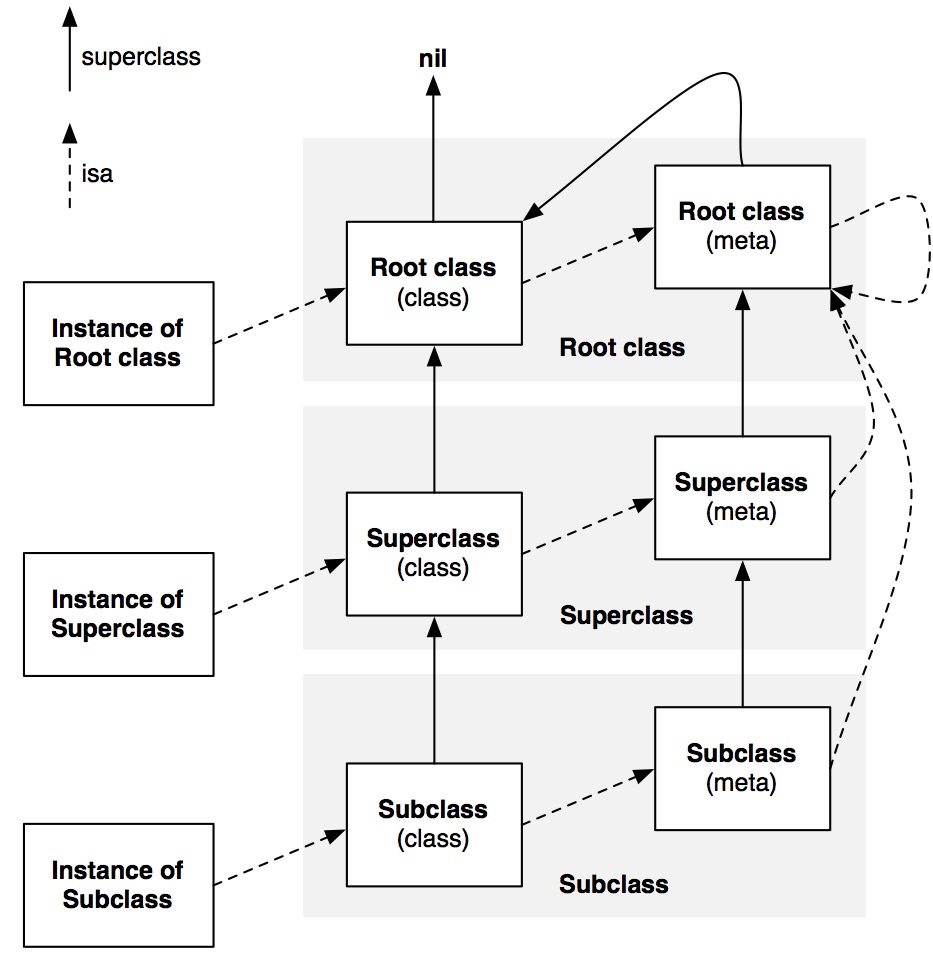
Every object is fundamentally an instance of a class. The class defines the list of member variables and methods. An object points to its class via the object's
isapointer.
Every class is fundamentally an object — a class is actually an instance of its metaclass (
metaclass). The metaclass defines the list of class methods. A class points to its metaclass via the class'sisapointer.
All metaclasses ultimately inherit from a root metaclass, whose
isapointer points to itself, forming a closed loop.