- Published on
UIView Properties: weak or strong?
I had always been using weak to qualify UIView properties in view controllers, but later noticed that some code does use strong for the same purpose. In fact, when I tried to initialize a view inside a block while using weak, I got a warning that only went away after switching to strong. It's worth understanding this properly, otherwise you'll never feel confident about the choice.
Many people, when explaining the difference between weak and strong, simply say: use weak for views and strong for models. Over time I've come to feel that this is increasingly inaccurate. strong for strong references is easy to understand; weak, on the other hand, was designed specifically to avoid retain cycles. The most typical retain cycle scenario arises when a view controller holds a reference to a view, and that view's dataSource or delegate is set back to the view controller.
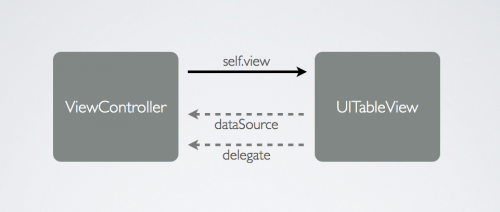
Apple's documentation states:
Outlets should generally be weak, except for those from File's Owner to top-level objects in a nib file (or, in iOS, a storyboard scene) which should be strong. Outlets that you create should therefore typically be weak, because:...
Mattt Thompson's article mentions:
Spurious use of strong ownership on a view outlet has the potential to create a retain cycle.
And raywenderlich's article:
Weak is the recommended relationship for all outlet properties. These view objects are already part of the view controller's view hierarchy and don't need to be retained elsewhere. The big advantage of declaring your outlets weak is that it saves you time writing the viewDidUnload method.
There are only two cases where strong should be used:
- Outlets that you create to subviews of a view controller's view or a window controller's window, for example, are arbitrary references between objects that do not imply ownership.
- The strong outlets are frequently specified by framework classes (for example, UIViewController's view outlet, or NSWindowController's window outlet).
Outlets should be changed to strong when the outlet should be considered to own the referenced object:
- As indicated previously, this is often the case with File's Owner—top level objects in a nib file are frequently considered to be owned by the File's Owner.
- You may in some situations need an object from a nib file to exist outside of its original container. For example, you might have an outlet for a view that can be temporarily removed from its initial view hierarchy and must therefore be maintained independently.
The gist of this is:
-
If an IBOutlet object is directly owned by the nib/storyboard scene's File's Owner, then clearly the owner must
directly holda pointer to that object, so the property should bestrong. All other IBOutlet properties should beweak, because the owner does not need todirectly holdtheir pointers. For example, a UIViewController'sviewproperty isstrongbecause the controller directly owns the view. Subviews added to that view only need to beweakas IBOutlets, since they are not directly owned by the controller — the controller's view owns them, and ARC handles memory management. -
Use
strongwhen the controller needs to directly control a subview and add it to a different view tree.
My personal understanding is that when using storyboards or nibs, there is already a strong reference chain from the view controller to its view and then to its subviews. Therefore, IBOutlet properties dragged out from Interface Builder are best declared as weak to avoid any potential retain cycles.
What about views created in code? For example:
self.strongView = ({
   UIView *strongView = [UIView new];
   [self.view addSubview:strongView];
   [strongView mas_makeConstraints:^(MASConstraintMaker *make) {
       make.left.top.equalTo(self.view).offset(64);
       make.height.width.equalTo(@80);
   }];
   strongView.backgroundColor = XTRandomColor;
   strongView;
});
If you don't use strong, you'll get the following warning:
Assigning retained object to weak property; object will be released after assignment
In practice, as long as there is no retain cycle, declaring a view as strong is perfectly fine. When the view controller is deallocated, both strong and weak views will be properly released, as long as there is no retain cycle.
Finally, although I was reluctant to admit it, I found that in this highly-voted Stack Overflow question, the discussion took an interesting turn. The accepted answer notes:
I asked about this on Twitter to an engineer on the IB team and he confirmed that strong should be the default and that the developer docs are being updated.
https://twitter.com/_danielhall/status/620716996326350848 https://twitter.com/_danielhall/status/620717252216623104
This further supports the general safety of declaring view properties as strong. There is no one-size-fits-all answer to the weak vs strong question — weak is primarily used to avoid potential retain cycles, not as a blanket rule for view properties.