- Published on
The Principles of Objective-C Runtime
Introduction
runtime: refers to the state of a program while it is running (or being executed). In other words, when you open a program and it runs on your computer, that program is in its runtime state. In some programming languages, reusable programs or instances are packaged or rebuilt into a runtime library. These instances can be linked or called by any program while they are running.
Objective-C runtime: a relatively low-level pure C language API, part of a C language library, containing many low-level C language APIs. When we write OC code and the program runs, everything ultimately gets converted into runtime C language code.
Objective-C is a dynamic language built on top of C with object-oriented features and a message-forwarding mechanism. This means it requires not just a compiler, but also a runtime system to dynamically create classes and objects, and to send and forward messages.
Runtime Data Structures
Reference: Objective-C Runtime — Part 1: Classes and Objects
In Objective-C, using [receiver message] syntax does not immediately execute the code of receiver's message method. Instead, it sends a message to receiver. This message may be handled by receiver, forwarded to another object, or silently ignored. In practice, [receiver message] is compiled by the compiler into:
id objc_msgSend ( id self, SEL op, ... );
SEL
SEL is the data type of the second parameter of objc_msgSend, representing a method selector. Its data structure in <objc.h>:
typedef struct objc_selector *SEL;
In essence, it is a C string mapped to a method. You can obtain an SEL-type method selector using the Objective-C compiler directive @selector() or the runtime function sel_registerName.
If you know the method name that corresponds to a selector, you can convert the SEL to a string using NSString* NSStringFromSelector(SEL aSelector) and print it with NSLog.
id
The data type of the first parameter of objc_msgSend is id. id is a generic pointer type that can represent any object. Its data structure in <objc.h>:
/// Represents an instance of a class.
struct objc_object {
    Class isa  OBJC_ISA_AVAILABILITY;
};

/// A pointer to an instance of a class.
typedef struct objc_object *id;
id is essentially a pointer to an objc_object struct. It contains a Class isa member; by following the isa pointer you can trace all the way to the class the object belongs to.
Note: According to Apple's official documentation Key-Value Observing Implementation Details, key-value observing is implemented using isa-swizzling. The
isapointer is modified at runtime to point to an intermediate class rather than the true class. Therefore, you should not use theisapointer to determine class relationships; use the class method instead.
Class
The data type of the isa pointer is Class. Class represents the class that an object belongs to. In <objc.h>:
/// An opaque type that represents an Objective-C class.
typedef struct objc_class *Class;
You can see that Class is simply a pointer to an objc_class struct. Let's look at the definition of objc_class in <runtime.h>:
struct objc_class {
    Class isa  OBJC_ISA_AVAILABILITY;

#if !__OBJC2__
	Class super_class; // pointer to superclass
	const char *name; // class name
	long version; // class version; default 0; can be read/written via class_setVersion and class_getVersion
	long info; // flag bits, e.g. CLS_CLASS (0x1L) is a regular class with instance methods and member variables; CLS_META (0x2L) is a metaclass with class methods
	long instance_size ; // size of instance variables (including those inherited from superclass)
	struct objc_ivar_list *ivars; // stores the address of each member variable
	struct objc_method_list **methodLists; // depends on info flags; CLS_CLASS (0x1L) stores instance methods, CLS_META (0x2L) stores class methods
	struct objc_cache *cache; // pointer to most recently used method, for performance optimization
	struct objc_protocol_list *protocols; // protocols the class conforms to
#endif
Note:
OBJC2_UNAVAILABLEis a macro Apple uses to constrain the runtime version of the Objective-C system, primarily for backward compatibility with pre-Objective-C 2.0 code. We can still extract useful information from it.
- isa: Represents the
Classof aClassobject — i.e., the MetaClass. In object-oriented design, everything is an object, andClassis itself an object in this design. Evidence can be found in<objc-runtime-new.h>, whereobjc_classis defined as:
struct objc_class : objc_object {
  // Class ISA;
  Class superclass;
  cache_t cache;             // formerly cache pointer and vtable
  class_data_bits_t bits;    // class_rw_t * plus custom rr/alloc flags

  ......
}
This confirms that the objc_class struct also inherits from objc_object, meaning Class is indeed an object in this design.
Meta Class is also a Class, so it has its own isa and super_class pointers like any other class, as shown below:
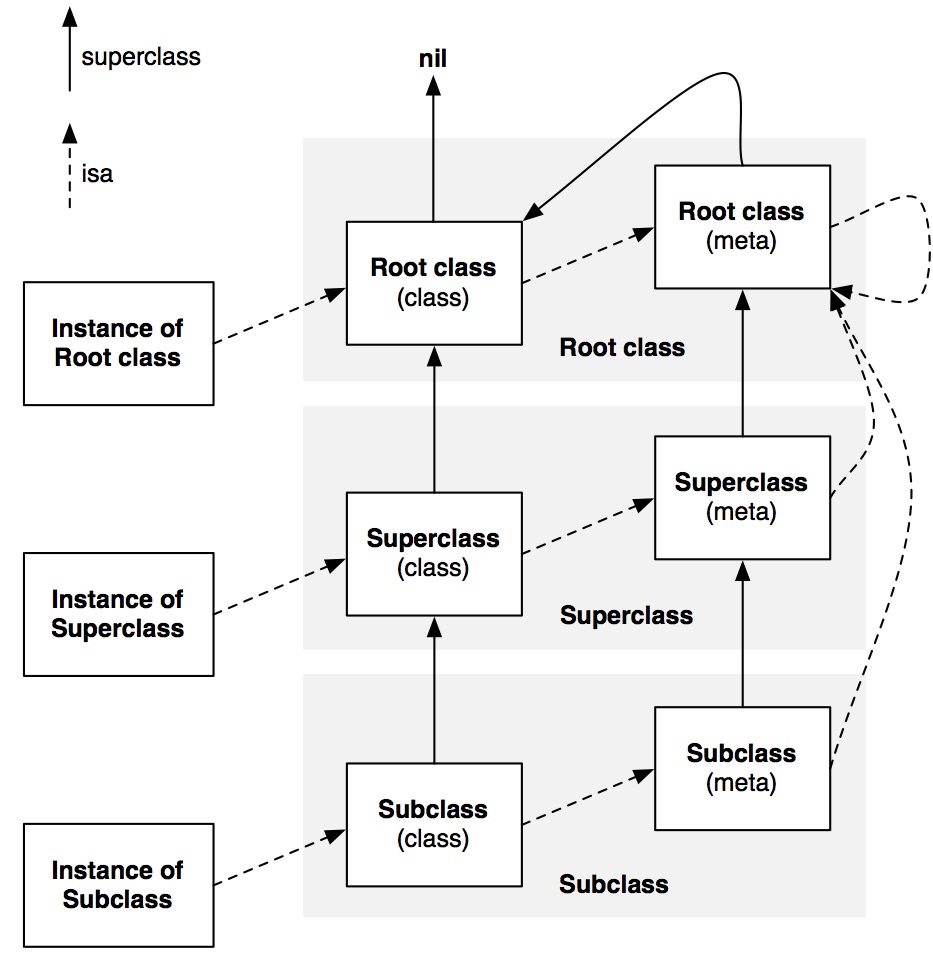
Solid lines represent super_class pointers; dashed lines represent isa pointers. A few key points:
Root class(class) is justNSObject.NSObjecthas no superclass, soRoot class(class)'ssuperclasspoints to nil.Every
Classhas anisapointer pointing to its uniqueMeta class.
Root class(meta)'ssuperclasspoints toRoot class(class) — i.e.,NSObject— forming a loop.Every
Meta class'sisapointer points toRoot class(meta).
- super_class: The superclass. If this class is already the topmost root class, this is
NULL. - version: Class version info, default 0.
- info: Some bit flags used at runtime.
- instance_size: The size of the class's instance variables.
- ivars: Represents multiple member variables; points to an
objc_ivar_liststruct.
struct objc_ivar_list {
    int ivar_count;
#ifdef __LP64__
    int space;
#endif
    /* variable length structure */
    struct objc_ivar ivar_list[1];
};
objc_ivar_list is essentially a linked list storing multiple objc_ivar entries, where each objc_ivar struct stores information about a single member variable.
- methodLists: Represents the method list; points to a double pointer to
objc_method_list. You can dynamically add instance methods by modifying*methodLists— this is how Categories work, and also explains why Categories cannot add properties.
struct objc_method_list {
    struct objc_method_list *obsolete;

    int method_count;
#ifdef __LP64__
    int space;
#endif
    /* variable length structure */
    struct objc_method method_list[1];
};
Similarly, objc_method_list is a linked list storing multiple objc_method entries, where each objc_method struct stores information about a specific method.
- objc_cache: Used to cache frequently accessed methods; points to an
objc_cachestruct, which will be covered in more detail later. - protocols: The protocols the class conforms to.
- Method: Represents a method in a class definition. In
<runtime.h>:
/// An opaque type that represents a method in a class definition.
typedef struct objc_method *Method;
struct objc_method {
    SEL method_name                                          OBJC2_UNAVAILABLE;
    char *method_types                                       OBJC2_UNAVAILABLE;
    IMP method_imp                                           OBJC2_UNAVAILABLE;
}
Method is a pointer to an objc_method struct, which stores the method name (method_name), method type encoding (method_types), and method implementation (method_imp). The type of method_imp is IMP — a function pointer.
- Ivar: Represents an instance variable in a class. In
<runtime.h>:
/// An opaque type that represents an instance variable.
typedef struct objc_ivar *Ivar;

struct objc_ivar {
    char *ivar_name                                          OBJC2_UNAVAILABLE;
    char *ivar_type                                          OBJC2_UNAVAILABLE;
    int ivar_offset                                          OBJC2_UNAVAILABLE;
#ifdef __LP64__
    int space                                                OBJC2_UNAVAILABLE;
#endif
}
Ivar is a pointer to an objc_ivar struct containing the variable name (ivar_name), variable type (ivar_type), and other info.
- IMP: As mentioned above when discussing
Method,IMPis fundamentally a function pointer that points to the method implementation. In<objc.h>:
/// A pointer to the function of a method implementation.
#if !OBJC_OLD_DISPATCH_PROTOTYPES
typedef void (*IMP)(void /* id, SEL, ... */ );
#else
typedef id (*IMP)(id, SEL, ...);
#endif
When you send a message to an object, this function pointer specifies the method's implementation and ultimately executes that code. This lets you bypass the message-passing stage and jump directly to a specific method implementation.
- Cache: As the name suggests,
Cacheis mainly used for caching. What does it cache? Let's look at its definition inruntime.h:
typedef struct objc_cache *Cache                             OBJC2_UNAVAILABLE;

struct objc_cache {
    unsigned int mask /* total = mask + 1 */                 OBJC2_UNAVAILABLE;
    unsigned int occupied                                    OBJC2_UNAVAILABLE;
    Method buckets[1]                                        OBJC2_UNAVAILABLE;
};
Cache is essentially a linked list of Method entries, primarily used to optimize method dispatch performance. When an object receiver calls method message, the runtime first uses the object's isa pointer to find the corresponding class, then searches methodLists for the method. If not found, it follows super_class to search the parent class's methodLists, and so on until the method is found and called. If still not found, message forwarding may occur, or the message may be ignored. However, this lookup approach is inefficient — typically only about 20% of a class's methods account for 80% of all calls. Using Cache to cache frequently called methods means method lookup checks the Cache first, and only falls back to methodLists if needed.
Supplemental Notes on Metaclasses (metaclass) and isa:
Core rule: An instance object's isa points to its class; the class's isa points to its metaclass.
In plain terms: instance methods are recorded in the class method-list; class methods are recorded in the metaClass. That is, instance-object information lives in the class-object, and class-object information lives in the metaClass.
The inheritance chain for class instance variables:
Every object is fundamentally an instance of a class. The class defines the list of member variables and methods. An object points to its class via the object's
isapointer.
Every class is fundamentally an object — a class is actually an instance of its metaclass (
metaclass). The metaclass defines the list of class methods. A class points to its metaclass via the class'sisapointer.
All metaclasses ultimately inherit from a root metaclass, whose
isapointer points to itself, forming a closed loop.
Code:
All code from this post can be found on my GitHub runtime_demo.